+852-69415941


377 Watch Battery (SR626SW) – Full Guide, Chemistry, and Replacement Tips
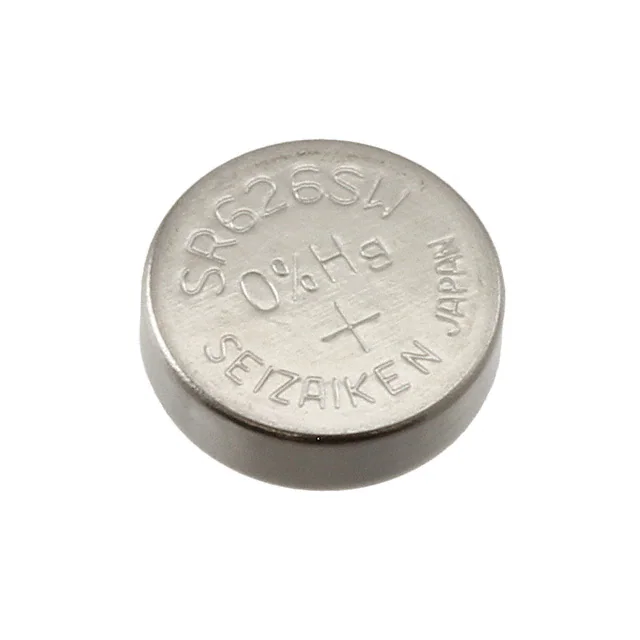
- Part No.:
- SR626SW
- Manufacturer:
- Seiko Instruments
- Category:
- Product information
- Package:
- Datasheet:
-
 SR626SW.pdf
- Description:
- BATTERY SLVR OX 1.55V COIN 6.8MM
- Payment:

- Shipping:

Article Details
- What Exactly Is a 377 / SR626SW Battery?
- Chemistry, Structure & Discharge Behavior
- Dimensions & Technical Specifications
- Performance Advantages vs. Alkaline
- Where the 377 Excels (Use Cases)
- Real-World Case: Seiko Quartz Battery Swap
- Step-by-Step Replacement Guide
- Troubleshooting After Replacement
- Brand Comparison & Quality Signals
- Standards, Safety & Environmental Notes
- Storage, Handling & Service Life Maximization
- FAQs
- Conclusion
What Exactly Is a 377 / SR626SW Battery?
The 377 (trade number) or SR626SW (IEC designation) is a silver-oxide coin cell sized to fit the majority of ultra-compact watch trays. It is optimized for low-drain, high-precision timekeeping: analog quartz movements, calendar modules, and miniature devices that need a stable 1.55 V supply for long periods. While alkaline look-alikes (marketed as LR626 or AG4) exist, they are not equivalent in performance or longevity.

Chemistry, Structure & Discharge Behavior
Electrochemistry: Silver-oxide cells use a zinc anode and a silver-oxide cathode in an alkaline electrolyte. The simplified reaction during discharge is:
Zn + Ag₂O → ZnO + 2Ag
This system delivers a remarkably flat discharge curve. In practice, the terminal voltage holds close to 1.55 V for most of the service life and only collapses near end-of-life. Quartz oscillators benefit directly: the stable supply keeps the IC divider chain and stepper motor torque consistent, minimizing time drift.
Internal structure: A 377 cell packages the chemistry into a laser-welded stainless-steel shell with a polymer sealing gasket. Materials are chosen for low leakage, low internal resistance, and dimensional stability. Premium brands tightly control cathode mix particle size, zinc purity, and separator porosity to ensure predictable performance across temperature extremes.
Dimensions & Technical Specifications
| Parameter | Typical Range / Value | Why It Matters |
|---|---|---|
| Chemistry | Silver Oxide (Zn/Ag₂O) | Provides stable 1.55 V output and a flat discharge profile. |
| Nominal Voltage | 1.55 V | Ideal for quartz timing ICs and stepper motors. |
| Capacity | ~25–28 mAh | Determines run time; varies by brand and load. |
| Diameter × Height | 6.8 mm × 2.6 mm | Must match watch tray tolerances precisely. |
| Operating Temp. | −10 °C to +60 °C | Watchable in winter outdoors and summer heat. |
| Leakage Rate | <0.1 µA @ 60 °C (typ.) | Lower leakage protects movements and extends shelf life. |
| IEC Code | SR66 | Useful for standard cross-references. |
| Common Labels | 377 / SR626SW / 376/377 / D377 | Different vendors use different trade numbers. |
Performance Advantages vs. Alkaline
End-users often ask whether an LR626 (alkaline) can substitute for SR626SW (silver-oxide). The short answer: it fits mechanically, but it is not the same electrically or chronometrically.
| Attribute | Silver-Oxide (SR626SW / 377) | Alkaline (LR626 / AG4) |
|---|---|---|
| Voltage Stability | Flat near 1.55 V until end-of-life | Gradual decline from ~1.55→1.2 V under load |
| Effective Capacity (watch load) | Higher, usable to near depletion | Lower; early voltage sag reduces usable life |
| Accuracy Impact | Minimal drift over service life | Time drift and early stoppage are common |
| Shelf Life | 4–6+ years (brand-dependent) | Typically shorter |
| Cost | Slightly higher | Lower upfront |
Where the 377 Excels (Use Cases)
- Quartz wristwatches: Analog three-hand, date/weekday complications, minimalist dress watches.
- Wearables & small instruments: Clip-on timers, small stopwatches, compact pedometers.
- Medical devices: Pen-type thermometers, compact glucometers (model-dependent).
- Precision gadgets: Calculators, mini data loggers, laser pointers with steady current draw.
In each scenario, the key requirement is consistent voltage at very low currents. The 377 supplies that better than alkaline alternatives.
Real-World Case: Seiko Quartz Battery Swap
After three-plus years of flawless timekeeping, a Seiko three-hand quartz on my desk finally stalled. A multimeter test registered the cell at ~1.22 V-below the movement's reliable torque threshold. I cracked the snap-back with a thin case knife (wrapped in tape to avoid marring), noted the "SR626SW" stamp, and dropped in a fresh Renata 377. The second hand resumed its crisp one-second steps immediately.
Two observations from this swap:
- Gasket inspection matters. A flattened or cracked case-back gasket invites condensation. Re-lube or replace if compromised.
- Contact hygiene is underrated. A quick wipe with lint-free tissue removed oxide residue. Poor contact can mimic a "dead" movement.
Step-by-Step Replacement Guide

Tools & Prep
- Watch case opener (knife for snap-backs, wrench for screw-backs)
- Non-metallic tweezers (or plastic-tipped)
- Soft cloth / watch mat, small tray for parts
- New SR626SW / 377 from a reputable brand
- Optional: loupe, multimeter, silicone grease for gaskets
Procedure
- Protect the case: Lay the watch face-down on the cloth. Note lug scratches are easy to inflict-work patiently.
- Open the back: Find the small relief notch for a snap-back, or engage a screw-back with a proper wrench. Avoid knives on screw-backs.
- Document orientation: Take a quick photo. The cell's "+" side typically faces up, but some trays differ.
- Remove the old cell: Release the retaining spring if present. Lift the cell with plastic tweezers to avoid shorting the top/bottom caps.
- Inspect & clean: Check the contact springs for oxide; remove dust with a blower. Lightly wipe contacts if tarnished.
- Insert the new 377: Match polarity exactly. Ensure the cell seats flat under the spring retainer; mis-seating causes intermittent resets.
- Gasket check: Ensure the rubber gasket is intact. A thin film of silicone grease can help re-seal snap-backs.
- Close & test: Press the back evenly until it snaps, or tighten the screw-back snugly. Observe the second hand-steady stepping indicates success.
Troubleshooting After Replacement
- No movement: Verify polarity; ensure the cell is fully seated and the retainer makes firm contact. Inspect for a movement insulator that may have shifted under the spring.
- Intermittent stopping: Check for play in the cell tray, contamination on contacts, or a bent retainer. Very cheap cells can sag under load-try a top-tier brand.
- Calendar misaligns: For date complications, set the time forward past midnight to confirm the calendar flips; re-sync AM/PM if needed.
- Water resistance lost: Replace any damaged gasket; pressure testing is recommended for swim-rated models.
Brand Comparison & Quality Signals
Silver-oxide coin cells are not all the same. Variations in zinc purity, separator chemistry, cathode mix, and sealing finish drive measurable differences in stability and leakage rate. A concise comparison:
| Brand | Model | Notable Strength | Typical Shelf Life | Notes |
|---|---|---|---|---|
| Renata | 377 | Swiss production, low leakage, tight dimensions | 5–7 years | Widely used by luxury watch OEMs |
| Murata (ex-Sony) | SR626SW | Excellent voltage tolerance, consistent lots | ~6 years | Highly regarded by watchmakers |
| Energizer | 377/376 | Global availability, reliable performance | ~5 years | Good value and easy sourcing |
| Maxell | SR626SW | Solid performance/price balance | 4–5 years | Common in everyday repairs |
Quality signals to check:
- Fresh production codes (avoid very old stock).
- Pristine packaging; no re-sealed blisters or smudged printing.
- Consistent cell height and firm retainer engagement when installed.
Standards, Safety & Environmental Notes
- Compliance: Modern 377 cells are mercury-free and RoHS compliant; manufacturing plants typically operate under ISO 9001.
- Standards: Performance definitions align with IEC 60086-3 (primary cells, watch use). The IEC code for SR626SW is SR66.
- Recycling: Do not dispose of coin cells in household trash. Use certified battery collection points where silver can be recovered safely.
Storage, Handling & Service Life Maximization
Silver-oxide has excellent shelf characteristics, but good handling can still extend life:
- Keep sealed and cool: 10–25 °C, low humidity, away from sunlight.
- Avoid metal mixing: Don't store loose cells with coins/keys-short-circuit risk.
- Fingerprints matter: Skin oils can form high-resistance spots. Use gloves or plastic tweezers.
- Periodic check: For stockrooms, rotate inventory FIFO and spot-test with a high-impedance meter.
Tip: If a watch draws unusually high current (e.g., sticky hands, dry pivots), even a new 377 will drain rapidly. Movement service may be required.
FAQs
Is a 377 battery the same as SR626SW?
Yes. 377 is a trade code; SR626SW is the IEC designation (SR66). They refer to the same 6.8 mm × 2.6 mm silver-oxide watch cell.
Can I use LR626 instead of SR626SW?
It fits physically but not functionally. LR626 is alkaline: its voltage drops steadily under load, causing time drift and shorter life. For watches, choose SR626SW / 377 (silver-oxide).
How long does a 377 last in a watch?
Typically 2–4 years under normal loads. High-torque movements, chronographs, or extreme temperatures reduce life; simple three-hand watches often exceed three years.
What if the watch still won't run after replacement?
Check polarity and seating, clean contacts, confirm the retainer spring hasn't slipped under the cell, and verify the gasket isn't obstructing the tray. If issues persist, the movement may need service.
Are 377 cells safe for medical devices?
Many pen-type thermometers and small diagnostic tools use SR626SW; always follow the device manual's exact specification and brand recommendation.
Conclusion
The 377 / SR626SW watch battery remains the benchmark for precision quartz movements because silver-oxide chemistry delivers what clocks demand: stable voltage, predictable discharge, low leakage, and tight dimensions. Choose a reputable brand, replace carefully with attention to polarity and gasket health, and your watch will tick reliably for years.
SR626SW Specifications
- Attributes
- Property Value
- Manufacturer
- Seiko Instruments
- Series:
- SR626
- Packaging:
- Tray
- Product Status:
- Obsolete
- Battery Chemistry:
- Silver Oxide
- Battery Cell Size:
- Coin, 6.8mm
- Voltage - Rated:
- 1.55 V
- Capacity:
- 28mAh
- Size / Dimension:
- 0.27" Dia x 0.10" H (6.8mm x 2.6mm)
- Termination Style:
- Requires Holder
- Features:
- -
- Category:
- Product information
The Posts
-
SEMITEC Constant Current Diode (CRD) Application Reference Guide
Current Regulating Diodes (CRD hereunder) are diodes that maintain a constant current flow despite voltage fluctuations. CRDs supply constant current over a wide range of voltage from sub 1V to 100V. C…

-
How to Test a 377 / SR626SW Watch Battery with a Multimeter
If you have a watch SR626SW battery that isn't working, you may be wondering how to test it. In this post, we'll learn, how to use a multimeter to test the watch battery. We'll also give you some tips…
-
SR626SW Cross Reference Chart: Compatible Battery Equivalents (377, AG4, D377, SR66)
Contents Why Cross References MatterNaming Systems Explained: IEC / JIS / Trade Numbers / GenericsSR626SW Cross Reference Chart (Brand-by-Brand)Size & Voltage CompatibilitySR vs LR vs CR: Don’t Confus…

-
377 Watch Battery (SR626SW) – Full Guide, Chemistry, and Replacement Tips
Discover everything about the 377 watch battery (SR626SW): its silver oxide chemistry, voltage stability, equivalents, lifespan, and replacement tips for watches. Includes expert insights and safety gu…

-
D Battery: Types, Specifications, Lifespan & Applications
The D battery, also known as an R20 or size D cell, is one of the largest standard cylindrical batteries used today. Known for its high capacity and long runtime, the D battery is a reliable power sour…

-
CR1025 Battery: Specifications, Features, and Applications
The CR1025 Battery is a 3V/30mAh coin cell Non-rechargeable Battery that features lithium manganese dioxide technology. It is suitable for use with low-drain devices and high-temperature applications.C…

-
IRF540N MOSFET: 100V N-Channel Power MOSFET Explained
Contents Pinout & PackageKey SpecificationsHow It WorksCircuit ExamplesThermal & Efficiency NotesIRF540N vs IRL540NEquivalents & AlternativesHow to Test with a MultimeterFAQWhere to BuyPinout & Package…

-
What Is an AG13 Battery? Size, Equivalents, and Applications Explained | BomKey Electronics
Looking for an AG13 battery? Learn its specs, common equivalents (like LR44, A76), typical applications, and how to choose the right replacement in this complete guide.
Stock: 1,316
Unit Price:$0
Ext Price:$0
| Qty. | Unit Price | Ext Price |
Inventory:1,316
Send us your inquiry,we will respond immediately.

-
CR2025
Murata Electronics
-
CR2032
Jauch Quartz
-
CR2025VP
Energizer Battery Company
-
CR2032
Panasonic - BSG
-
CR2032VP
Energizer Battery Company
-
E92VP
Energizer Battery Company
-
CR2032
FDK America, Inc., a member of Fujitsu Group

-
CR2016
Panasonic - BSG
-
CR2016
Murata Electronics
-
A76
Energizer Battery Company
-
E96VP
Energizer Battery Company
-
LR6XWA/BXU
Panasonic - BSG
-
CR-2025L/BN
Panasonic - BSG
-
CR2032
Murata Electronics
-
LR03XWA/B
Panasonic - BSG
-
CR2025
FDK America, Inc., a member of Fujitsu Group
-
CR1616
Panasonic - BSG
-
A23C
Energizer Battery Company
-
LR03XWA/2SB
Panasonic - BSG
-
EN91
Energizer Battery Company
Latest News
- Taiwan's First MEMS Pressure Sensor Manufacturer — Metrodyne Microsystems
-
2019.09.11
Bomkey Electronics Co., Ltd. is the authorized distributor of the full range of Metrodyne pressure sensors.
- 377 vs 376 Battery: What’s the Difference?
-
2025.10.31
Contents 377 vs 376Same Size, Same Chemistry — Why Two Versions?Low-Drain vs High-Drain: What “Drain” Really MeansVoltage & Discharge Behavior Under Real LoadsAre 377 and 376 Interchangeable?Cross…
- How to Charge a Capacitor Without a Resistor – Safe Methods & Precautions
-
2025.10.29
How to charge a capacitor without a resistor safely. Understand current surge risks, safe charging methods, and best practices for power electronics.
- What Are Silicon Capacitors? Features, Applications, Brands, Models & Buying Guide
-
2025.10.16
Silicon capacitors represent a new generation of passive components that combine high performance, excellent stability, and miniaturization. Built using semiconductor manufacturing techniques on silico…
- Sudden Sanctions Imposed! The U.S. Government Adds 23 Chinese Entities Including Fudan Microelectronics to Its "Blacklist", Bringing the Total Number of Entities on the List to Over 1,000
-
2025.09.13
On September 12 local time, the U.S. Department of Commerce's Bureau of Industry and Security (BIS) issued an announcement stating that it had revised the Export Administration Regulations (EAR), addin…
- Murata Launches World's First 10µF/50Vdc MLCC in 0805-inch Size for Automotive Applications
-
2025.08.15
Automotive-grade Capacitor6/26/2025Murata Manufacturing Co., Ltd.President:Norio NakajimaMurata Manufacturing Co., Ltd. has announced the new GCM21BE71H106KE02 multilayer ceramic capacitor (MLCC) has e…
- Murata Begins World's First Mass Production of 47uF Multilayer Ceramic Capacitor in 0402-inch Size
-
2025.07.18
FeaturesMurata has become the first in the industry to mass-produce a miniaturized 0402-inch (1.0×0.5mm) multilayer ceramic capacitor (MLCC) with a capacitance of 47uF.Can operate in high-temperature …
- How to Read a 2.2K Resistor: Color Code, Identification, and Practical Use
-
2025.06.24
How to Identify 2.2K Resistor: Color Code, Circuit and ApplicationsIf you're working with electronics, you need to know how to read resistors. 2.2k ohm resistor: Probably the most used resistor in ci…
- 100 Ohm Resistor Color Code Guide
-
2025.06.19
What Is a 100 Ohm Resistor?The 100 ohm resistor holds a prominent place among electronic components due to its wide range of applications and ease of use. Its frequent appearance in electronic circuit…
- 357/303 Battery Equivalent: Interchangeability, Differences & Best Replacements
-
2025.06.19
Explore the differences and similarities between 357 and 303 batteries. Understand their equivalents, compatibility, voltage, and the best replacements for watches, calculators, and medical devices.
- What is a 100 Ohm Resistor? Color Code,Uses and Everything You Should Know
-
2025.06.03
100 ohm resistor is a passive electrical component that resists the flow of current by 100 ohms. In simple terms, it acts like a speed bump for electricity - slowing down the current to protect other c…
- The core components of data storage and information perception
-
2025.01.15
In today's era of rapid digital information development, memory and sensors are like the "memory center" and "sensing antenna" of electronic devices, respectively, shouldering the important mission of …


- Low price every day, worry-free selection

- Genuine licensed goods, exquisite service

- Multi-warehouse direct delivery, fast delivery

- Complete range for easy shopping